The City of St. Petersburg has wrapped months of Advanced Air Mobility (AAM) Task Force meetings, outlining how electric aircraft could soon be taking off and landing close to home.
eVTOLs, or electric vertical takeoff and landing aircraft, are not helicopters. They’re battery-powered, quieter, and designed for short, efficient trips. Built with simpler systems, they have the potential to lower training barriers and expand access to aviation. More importantly, they are designed for connectivity – short hops across the region, like St. Pete to Tampa or from downtown to the beaches.
At the center of the task force’s recently published report is Albert Whitted Airport, where its role in accommodating Advanced Air Mobility was a primary focus.
Here are the top things to know about the report and the future of air mobility in St. Pete.
Aviation is part of St. Pete’s identity and will remain that way.
St. Petersburg cemented itself in aviation history in 1914, becoming the birthplace of the first commercial flight. Later, National Airlines, which evolved into Pan Am, began at Albert Whitted Airport. Now, St. Pete has a chance to lead, not just react to the next wave of transportation.
Recommendations from the Advanced Air Mobility Task Force address a phased plan to integrate air taxis and emerging aviation technologies into the city’s infrastructure. Beyond infrastructure, the report positions St. Pete as an innovation hub through the proposed “Jannus Center for Aviation and Innovation”, focused on workforce development, research, and industry partnerships.
Albert Whitted Airport is resourceful.
The Advanced Air Mobility Task Force does not overlook the unique features of the airport, from waterfront proximity to events like the Grand Prix. Required runway separation standards leave limited options for a dedicated vertiport without impacting existing uses. Figure A in the report, adapted from the airport’s 2023 master plan, illustrates this clearly, with potential vertiport locations shown in red boxes.
Recommendations focus on using what already exists without waiting for entirely new infrastructure. Initial eVTOL service can begin using existing runways, much like helicopters operate today by sequencing alongside fixed-wing aircraft, maintaining the airport’s core function as an active general aviation hub.
In the near term, the task force outlines practical upgrades: designated AAM parking, electric charging infrastructure, and enhanced fire safety systems. As demand grows, the report recommends an Alternatives Analysis to determine where a dedicated vertiport can be developed without conflict. Any long-term buildout is intentional, phased, and designed around the principle that AAM must not detract from existing aeronautical operations.
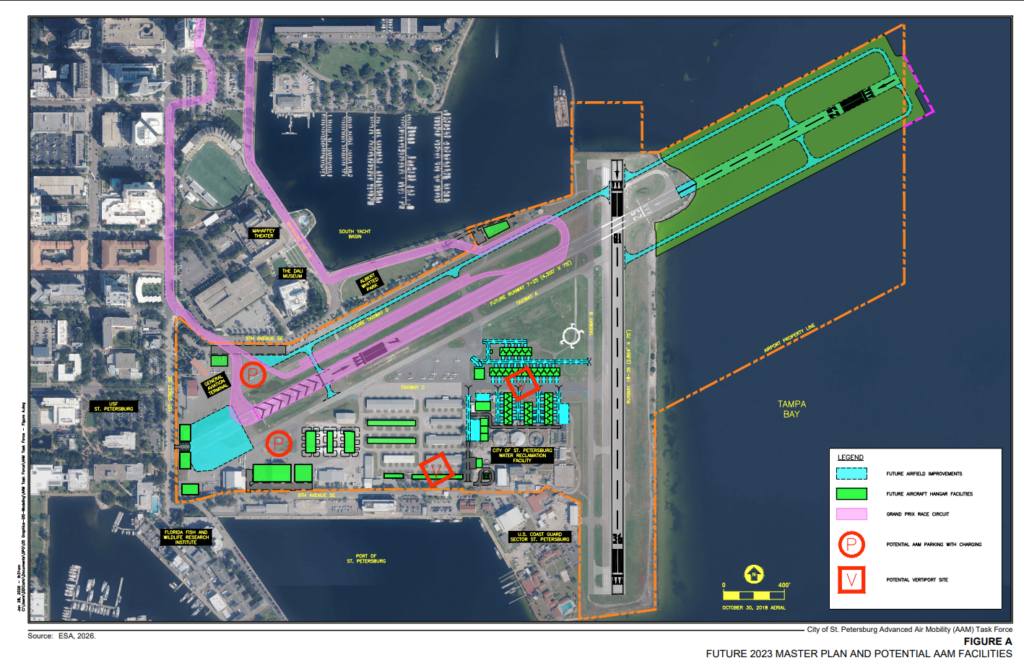
Figure A from the AAM Task Force Report shows potential vertiport sites.
The future is not far away.
According to projections presented by the Hillsborough County Aviation Authority to the task force, Advanced Air Mobility will scale in phases as complexity grows. Certification, testing, and evaluation began in 2022 and will be completed in 2026, with initial deployment expected between 2027 and 2030. You can see operations in a few cities as early as 2030. Looking ahead, 2045 could see fully automated operations in multiple cities.
Advanced Air Mobility is widely supported.
The Task Force is positioning St. Pete to participate in an industry already moving forward at the state, national, and global level.
The market itself is scaling rapidly. According to the report, the $12 to $15 billion Advanced Air Mobility industry is projected to reach roughly $30 billion by 2030 and potentially exceed $100 billion by 2035. Investment is coming from both new entrants and established aviation players, including major airlines and cargo operators, signaling long-term confidence in its growth.
The Advanced Air Mobility Task Force, chaired by Ed Montanari, first convened in April 2025 to study and make recommendations on how St. Petersburg should prepare for advanced air mobility. The task force included representatives from across the city, such as Walt Driggers, Executive Director of Albert Whitted Airport, and Alison Barlow, CEO of the St. Pete Innovation District. These bright minds worked closely with regional experts to develop recommendations that are practical, forward-looking, and tailored to the city’s needs. You can read the full report here.
April 2026
Nisuka Williams