The heat of the day begins early during a Florida summer. Students are off school and jumping right back into another lesson. Pilots hope their training is scheduled in the first hours of the morning before the heat settles over the ramp. Wait too long, and you’re either flying through the heat or watching afternoon thunderstorms roll in.
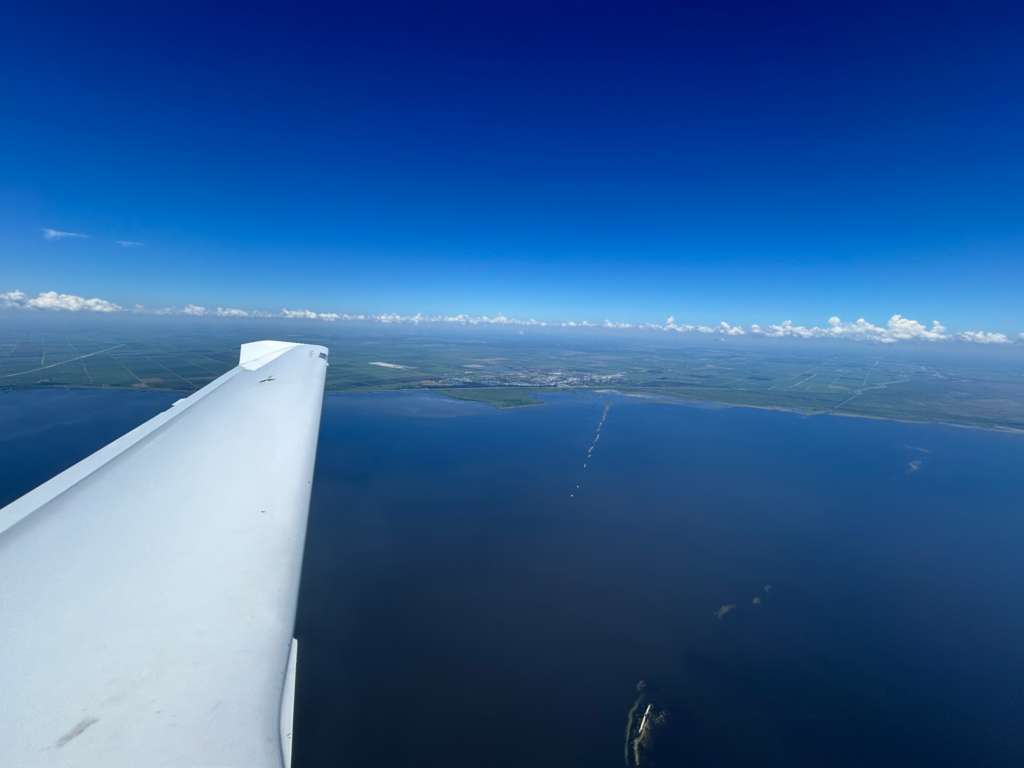
Cumulus clouds in the distance during a summer flight
Everett, a Friends of Albert Whitted Airport scholarship recipient, knows that routine well. He’s spending his summer balancing flight training, a new job at the airport, volunteer opportunities, and hours of studying.
Training and volunteering at Albert Whitted Airport while working line service at St. Pete-Clearwater International Airport (KPIE), he’s being exposed to all sides of aviation. He began working at Sheltair in June.
“You think you know airports,” he said, “and then you work at one.”
His familiarity with training aircraft at Albert Whitted serves him well. Now he’s fueling larger turboprops and jets, taking that knowledge back into his own flight training.
Helping tow business jets into crowded hangars has strengthened his awareness of aircraft size, wingspan, and precise aircraft movement. The confidence he’s developed while maneuvering airplanes on the ground has carried over into the cockpit, where smooth, controlled aircraft handling is equally important.
Finding Time to Fly
Starting a summer job also means adapting to a new flight training schedule. Working during the day often leaves evenings as the only opportunity to fly. Some could see summer as a tough season for training. A lot has to line up between work, weather, and flying. Balance and flexibility are key.
What summer does lend itself to is time on the ground studying for FAA knowledge exams.
After earning his instrument rating earlier this year, Everett’s focus has shifted to completing the remaining commercial requirements, including his long night cross-country flight, preparing for the commercial knowledge exam, and building experience before his eventual checkride.
From Studying to Social Networking
This summer hasn’t just been about flying. It’s also been about meeting people.
Everett says one of the biggest lessons he’s learned is the importance of networking within the industry. A firm handshake and good conversation with a senior pilot go a long way. These moments become opportunities to ask questions, learn from experience, and build relationships within the aviation community.
His volunteer work has reinforced that lesson. While helping with a Boy Scouts Aviation Merit Badge program, Everett introduced young students to the basics of flight, explaining control surfaces, aircraft systems, and aviation fundamentals.
Network up, down, and sideways. That means a student pilot can learn from a first officer, lean on fellow line technicians for support, and be the person who inspires the next generation of young aviators.
In just a few months working at the FBO, Everett has found himself surrounded by others working toward aviation careers. During slower days, they’re all studying together and bouncing questions off one another. One coworker is working toward an instrument rating, another hopes to become a helicopter pilot, and Everett is preparing for his commercial certificate.
Everett earning the Advanced Flight Scholarship from Friends of Albert Whitted Airport
The Seasons Ahead
As summer winds down, a pilot’s training doesn’t.
Everett is committed to making the most of the support provided through the scholarship program as he completes the next phase of his flight training. Beyond that, the possibility of earning a degree in aviation remains while continuing to build the experience needed for a professional flying career.
For now, though, he’s content with the rhythm of summer: early mornings on the ramp, evenings in the cockpit, studying whenever thunderstorms roll through, and taking advantage of every opportunity that comes his way.
August 2026
Nisuka Williams